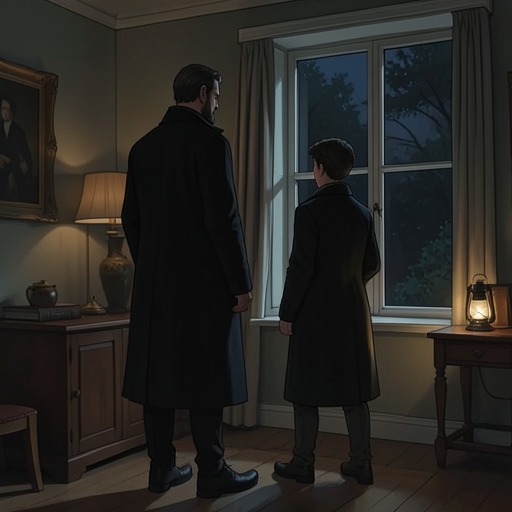
Peter Quent's death
The Turn of the ScrewPeter Quint’s death is the concealed event that makes his later appearances at Bly seem impossible: Mrs. Grose tells the governess that Quint is dead, and the governess’s retrospective account describes his body being found on a winter morning after a fatal fall. The inquest treats the death as accidental, but the story’s order of disclosure allows the fact of death to deepen rather than dispel the mystery surrounding him.
Disclosure and Immediate Response
Mrs. Grose hesitates before telling the governess that Quint, too, is gone. Asked where he went, she answers that she does not know, then states plainly that he died. The governess reacts with near disbelief; Mrs. Grose repeats the fact more firmly, identifying Quint as dead.
The revelation does not settle what the governess has seen. Instead, it brings the two women together in a new and painful knowledge: the governess is liable to vivid impressions, while Mrs. Grose now understands the extent of that liability. They retreat to the schoolroom, shut themselves in, and spend the evening in tears, prayers, promises, and mutual pledges. Mrs. Grose has seen nothing herself, but the reported death makes the governess’s experiences harder to contain within ordinary explanation.
The Reconstructed Accident
The governess later supplies the circumstances behind Mrs. Grose’s brief announcement. Quint had spent months continuously at Bly. His death occurred on a winter dawn, when a laborer going to early work found him dead on the road from the village.
A visible head wound supplied the apparent explanation. After leaving the public house, Quint had been in liquor, taken a wrong turn in the dark, and slipped on a steep, icy slope. The inquest and the ensuing local talk accepted the fall as the practical explanation of his death. The account is therefore concrete about the official cause, even as it retains uncertainty about the larger history surrounding him.
Rumor, Secrecy, and Narrative Effect
The accident explains how Quint died, but it does not make his life seem ordinary. The governess recalls strange episodes, dangers, suspected vices, and secret disorders associated with him—matters that, in her view, could explain more than the fall alone. The distinction between the inquest’s answer and the troubling reputation attached to Quint keeps the death from functioning as a complete resolution.
The event is disclosed in stages: first Mrs. Grose’s emphatic confirmation, then the governess’s retrospective reconstruction of the body, the road, and the icy slope. Because the reported death precedes the later ghostly encounters in the narrative, it acts as a destabilizing fact rather than a clean boundary between life and haunting. The accident offers a plausible physical account; it cannot settle what the governess’s visions mean.